Upper Valtellina: big woodland fire-fighting exercise
Tue, 03/11/2026 - news
Tue, 03/11/2026 - news
Upper Valtellina: big woodland fire-fighting exercise
The formidable response machinery of the Civil Protection and rescue services operating in difficult terrain, belonging to various organisations and institutions, was set in motion on Saturday 17 October at the stunning Cancano lakes, in the Municipality of Valdidentro.
This was not a real emergency, but a complex and well-structured Wildfire Fighting exercise (AIB) organised by the Comunità Montana Alta Valtellina.
The operation, planned under the direct supervision of the organisation’s operational lead, Michele Zanoli, put to the test the speed of the response, the reliability of radio communications, and cooperation among volunteers from different units operating in high-risk scenarios.
Over 70 people were deployed in the field during the training, including volunteers from the local AIB teams, Civil Protection personnel, and professionals from Soccorso Alpino and the Guardia di Finanza.
Running the complex tactical and firefighting manoeuvres were two Directors of Fire Suppression Operations (DOS), Urbani Gerardo and Trinca Rampelin Fausto, who—together with the coordinator of the hosting Civil Protection section, Matteo Rocca—coordinated the different dynamics that involved the volunteers stationed across the area.
Field testing and the strategic role of drones
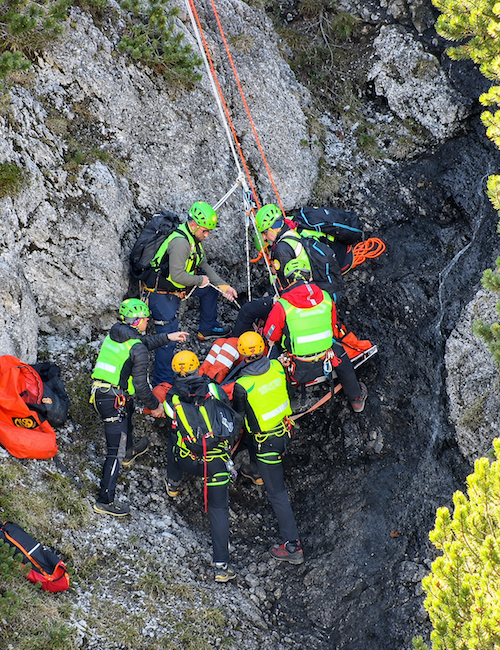
Alongside the classic fire-containment manoeuvres, focused on checking the teams’ response times, the correct use of hydraulic equipment and the laying of hose lines, this year’s edition introduced a special focus of exceptional technical complexity: the simulation of an injured volunteer in difficult terrain, followed by a recovery carried out by the relevant bodies, such as Soccorso Alpino and SAGF.
In this scenario, technology played a central role thanks to the Province of Sondrio’s UAS module (drones).
The light aircraft guided by pilots from the province, led by the newly appointed operations lead Andrea Mazzoni, didn’t just locate the injured person beneath the blanket of smoke. They served a dual strategic purpose: providing continuous support to the operations by assessing from above how the fire front was developing, and ensuring the safety of the Soccorso Alpino and SAGF technicians throughout the entire manoeuvre by monitoring potential environmental hazards in real time.
Rescue on a stretcher and investigations into the cause of the blaze
Once the injured person had been identified, the delicate vertical and medical recovery procedures were set in motion.
Under the watchful eye of the drones, Soccorso Alpino technicians (CNSAS) and the Guardia di Finanza’s Soccorso Alpino military unit (SAGF) from Bormio worked in close synergy. Mountain rescue specialists reached the casualty, stabilised them, and, overcoming steep gradients and the hazards of alpine terrain, strapped them onto a stretcher and transported them safely to the valley below.
Alongside the firefighting and rescue operations, the exercise also included the crucial investigative phase. The Carabinieri Forestali of the Parco Nazionale dello Stelvio (Valdidentro Station) were deployed at the perimeter of the fire to begin investigations and the scientific surveys needed to assess the nature of the blaze, determining whether the origin of the outbreak was deliberate or accidental. A presence that underscored the importance of investigative work and environmental protection even during the most intense emergency phases.
The organisation’s lead’s assessment
The organisation’s lead, Comunità Montana, Michele Zanoli, expressed deep satisfaction at the end of the training day:
“The presence of over 70 operators and the perfect integration between technological systems such as drones and Civil Protection A.I.B. volunteers—specialised units of Soccorso Alpino and the Guardia di Finanza—show just how high the reactivity level of our system is. Testing the rescue operation on an injured volunteer allows us to guarantee the maximum safety for people who, day after day, risk their lives firsthand to defend our woodland heritage.”
The exercise concluded in the first afternoon hours with a logistical debriefing and a community lunch, confirming the effectiveness of the alpine safety network and the extraordinary dedication of the women and men who keep watch over the protection of the valleys and the fragile ecosystems of Alta Valtellina.