The house and the legend of the Venetian captain
Ca’ d’Otello is said, according to local tradition, to have been named after a Venetian captain nicknamed “il Moro” for his dark complexion, who here would have killed his wife, believing her to be unfaithful.
A tale that some people even link to the inspiration behind the Shakespearean tragedy of Othello.
But the strongest connection to the English playwright is about another story: that of a child born with a different surname, Crollalanza.
The surname that sparked debate
Here’s the curious thing...
In English, “crolla” is “shake”. “Lanza” becomes “spear”. Put the two words next to each other and read them quickly: Shakespeare.
This isn’t a random wordplay.
In 16th-century England, translating your own surname, or your family name, was something immigrants really did—especially if they were running from something and wanted to disappear into a new identity.
And according to this theory, that’s exactly what would have happened to a child born with the surname Crollalanza: the family translates it, anglicises it, and that translated name becomes the signature on some of the world’s most famous works of literature.
Those who back the theory also give the reason for the escape. Michelangnolo (spelled exactly like that) Crollalanza would have been born into a Calvinist family, at a time and in a place where being Calvinist meant having the Inquisition right on your heels. Leaving for England, where the maternal relatives had already translated the surname into the local language, meant getting away and starting again under a different identity.
A surname that becomes another surname. An escape that turns into a new life. And a new life that, centuries later, becomes the most famous name in English theatre.
Where this story comes from
This story didn’t start in Tresivio, and it certainly wasn’t yesterday. The first person to bring it up was a journalist, Santi Paladino, who, in 1927, wrote a cracking article titled: “The great tragic Shakespeare might have been Italian”. He liked the idea so much that he wrote about it in two more books, in 1929 and 1955.
Then, in 2002, a professor arrives—Martino Iuvara—who takes everything up again and pushes it further south. In his book Shakespeare era italiano, the cradle isn’t Valtellina anymore, but Sicily. Even today, it’s the text most often cited by anyone telling this story, although, over time, other books like it have also come out.
And here’s what’s interesting: even people who believed in it never agreed on where this mythical “Italian Shakespeare” was really born. Some say Messina, others say Tresivio.
A legend that, over the years, has changed its home again and again—almost as if it even didn’t know where it was supposed to belong.
Giorgio Gianoncelli’s book
Then there’s also someone who devoted a whole book to the question. Giorgio Gianoncelli, a local historian who’s now passed away, wrote “William Shakespeare. Inglese, siciliano o valtellinese perseguitato. Tra realtà e fantasia” (Edizioni Polaris).
The title says it all on its own: it lays out the hypotheses without unravelling the knot. The material and the volume were provided by his family, and it’s the main source this article refers to for the Valtellina side of the story.
What needs to be said clearly
No historical document confirms this theory. No birth record, no evidence that would stand up to the historians of English literature, who see the Italian origin of Shakespeare as a fascinating notion—but not a solid academic thesis.
That said, a legend that survives for a century without any proof to back it up still says something. It says that in Tresivio they still enjoy telling it. And perhaps, in the end, you don’t need a document to keep a story alive. You just need someone to keep telling it.
We’re telling it in video too
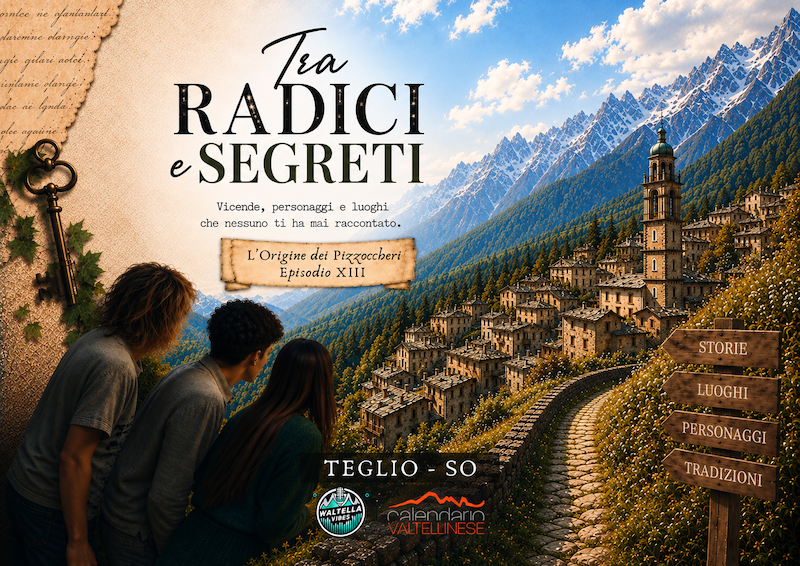
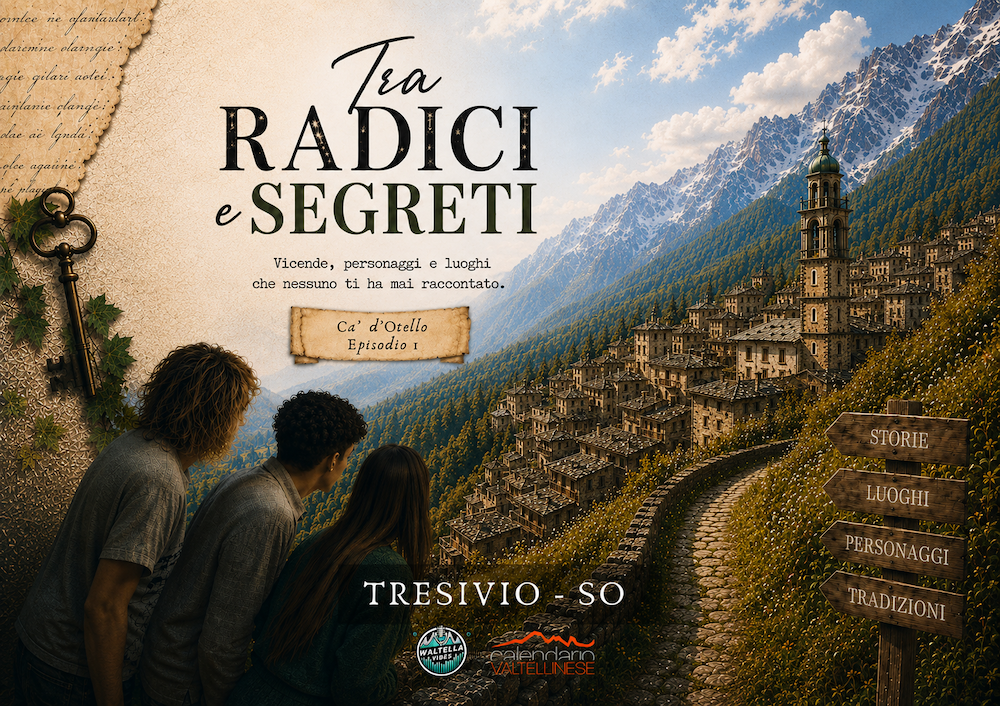
The legend of Ca’ d’Otello takes centre stage in the first episode of Tra Radici e Segreti, the video series that sees the collaboration between Calendario Valtellinese and Waltella Vibes, taking you around Valtellina to meet characters and places nobody has ever told you about.
If you want to watch the reel again, you’ll find it on our YouTube profile