La caurabesula
Tue, 29/04/2025 - Curiosities
Tue, 29/04/2025 - Curiosities
La caurabesula
Discover how much is truth and how much is legend....
When I was little with my brothers, and sometimes in the company of my cousins, we would go during the school holidays to the house in San Bernardo.
We stayed there from June to September. The sea was only known from the postcards we occasionally found in the mailbox in Ponte,
sent by some relative. [It was months of games and carefree days: we were free to wander through woods and paths without roads or cars].
In the hut below the house were our "famigli": the *Rosa di Pitu* and the *Rosa di Leli*. From time to time, I would go down to visit them. Once, scared, I asked
*Rosa di* *Leli* whose strange sound was coming from the forest of *Rotonda,* I remember she told me:
*L'è al Caurabesul!" .*
I have always been curious about that name and what that creature could be: in my child's imagination, I thought of it as half bird and half
goat. Some time ago, reading a local magazine, I was finally able to satisfy a curiosity I had long set aside, and I find it increasingly fitting
the saying *L' è fina 'n pecà murì, perché se 'npara una ogni dì!*
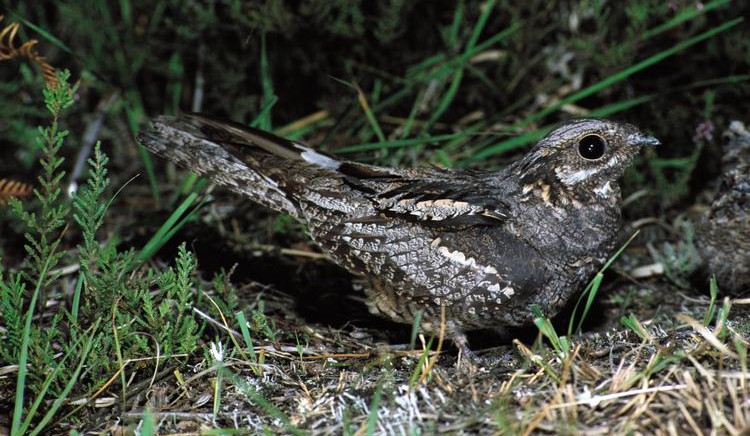
In reality, the *Caurabesul or Caurabesula,* which translated means "goat that bleats" since *besulà* in dialect means precisely ''to bleat,'' is a harmless
bird, about the size of a blackbird called in Italian *Succiacapre*. Its bad reputation comes from shepherds convinced that it sucked milk
from the teats [mammelle] of goats, drying them out! Instead, it seems that the little bird followed them only to feed on the insects infesting their
plumage. The constant and crackling song of the succiacapre, combined with its forced nocturnal habits, has made it an archetype of a "cursed" animal
in popular legends, that is, a spirit in the form of an animal tasked with collecting the souls of the dying to take them
to the afterlife.
The popular belief here in Valtellina has embroidered the story, saying that the little bird was actually a witch wandering through the woods waiting
to gather with other colleagues at Lake Painale - at the top of Val di Togno on the borders with Valfontana-, not far from San Bernardo and
the usual meeting place for sabbaths. Another version among many claims that the "Caurabesula" is the cry of an abandoned newborn, crying
within the tangled thicket of a woods. Not having known this before, as a child, saved me from restless nights in San Bernardo...
Testimony of Giovanni Bolognini