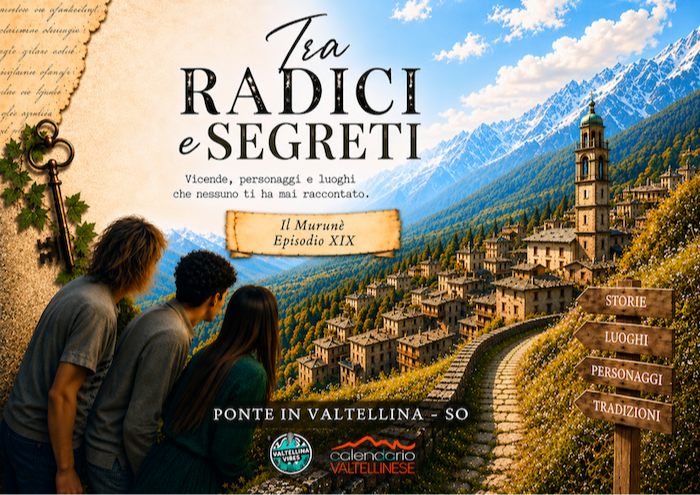
It’s a white mulberry (Morus alba) and it stands in Sant'Ignazio Street, at the corner with Vicolo Foppoli, among the old buildings of Palazzo Foppoli, which used to be called Quadrio. The provincial survey describes it as roughly ten metres tall, with a trunk of more than four metres in circumference.
No one knows its exact age. A publication from the Ministry estimates it at around six hundred years, a school newsletter from 2016–2017 talks about four hundred, and the provincial census notes that people in the area said it was already a hundred years old back in the seventeenth century. That’s why we call it the centuries-old mulberry: it’s the safest definition.
The thing that really stands out when you look at it is its shape. It has three large branches growing out low down, a twisted main trunk, and swellings which, in the descriptions, are called “moro’s heads”. The provincial survey explains them as numerous pollarding cuts, meaning repeated pruning of the branches carried out to collect the leaves.
And those leaves were used to feed silkworms. So, for generations, this tree was repeatedly cut back and then left to grow again, and each cut left its mark. What we see today is also the result of all that work. As for where the leaves were collected and where the silkworms were reared, the documents don’t say.
There’s a historical photo, attributed to Edwin Fehr and dated somewhere between 1948 and 1960, kept by the Biblioteca civica Libero Della Briotta in Ponte. There, the structure of the tree is much clearer than it is now, because today the vegetation partly hides it. Another photo from the same series shows the hollow trunk.
A curiosity: the lower part of the trunk isn’t visible. If you look at the house behind it, it’s much lower than the tree, and the reason lies in the road level, which has risen over time. A fact sheet from Lombardia Beni Culturali mentions a raised embankment that lifts the Murunè above the old road level. According to the children at the Ponte school, who wrote about it in the 2016–2017 newsletter after an outing with a local expert, it would have been covered with earth and stones taken from the roads after a number of floods. In Ponte, they were used to dealing with water: in Sant'Ignazio Street, the üs'cére are still there—those large wooden barriers we talked about in the previous episode. But when it happened, and how much trunk is below, nobody knows.
Even the name has its variations. In the sources you’ll find Murunè, muruné, murunée, and in Ponte there are people who write “al Murunèe”. In the Chiuro and Castionetto vocabulary, muruné means the mulberry, so the local name simply means that.
In recent years, the Murunè has also drawn attention. In 2014 the press reported on the Swiss foundation ProSpecieRara’s interest in taking samples and propagating it. On 13 February 2016, there was a training check with the Giussano Arboriculture Studio, including a visual assessment of stability and the collection of pruning material.
If you’re passing through Ponte, go and find it in Sant'Ignazio Street—and look at it thinking about all the hands that have pruned it.