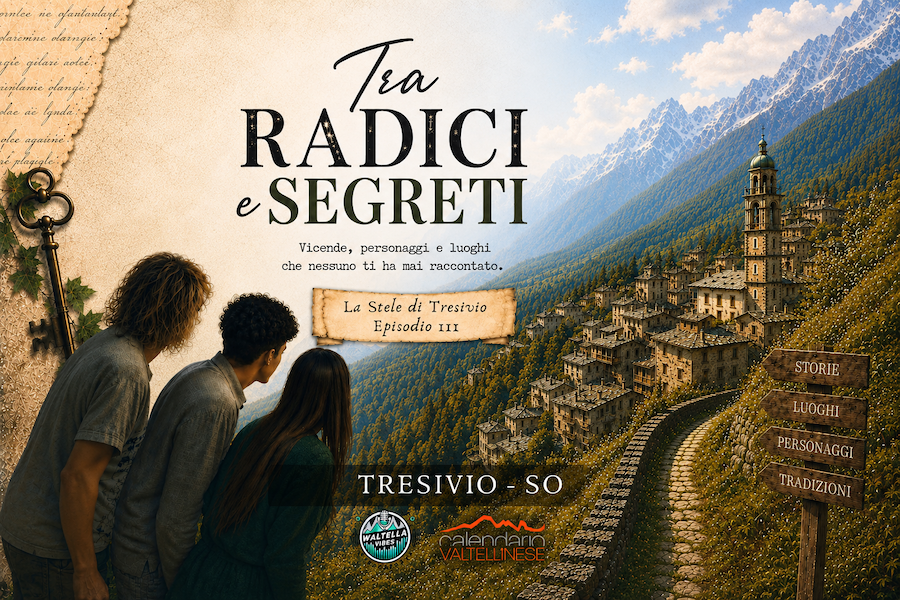
The find: 31 March 1871
On 31 March 1871, a labourer is digging the foundations of a house in Tresivio.
At one point, his shovel hits something solid. It isn’t just any kind of rock. It’s a stele—bearing an engraved inscription.
The news spreads immediately. The stele is studied, measured, and sketched. But its meaning remains, to a large extent, a mystery.
Today, that artefact is kept at the MVSA – Museo Valtellinese di Storia ed Arte in Sondrio, and it’s considered one of the most important documents for understanding who lived in the Valtellina before the Romans.
Who wrote it and when
The stele was made by a population that lived in these valleys before the Roman conquest.
Scholars link it to the Raetian world and to the Camunian world—meaning the peoples who lived in the central Alps between the first millennium BC and the first centuries of the Roman era.
The alphabet used is very similar to that of the famous Raetian inscriptions and the engravings from Val Camonica.
The inscription is short, but packed with names and formulas. The name Sondrio (or something very close to it) appears, written in an ancient form that has had scholars debating for decades.
Some read “Sondrio on this side and that”, while others offer different interpretations. But one thing is certain: the stele is one of the earliest testimonies to the name of the capital of Valtellina.
Why it’s so important
The Stele of Tresivio matters not only for Tresivio or for Sondrio.
It’s among the archaeological finds of greatest historical and archaeological value—not just in the province of Sondrio, but across the entire Valtellina.
Because:
- it’s one of the few long, complex inscriptions in the Raetian alphabet found in the Valtellina;
- it preserves a place-name that we can still recognise today;
- it tells us who lived in these valleys before the arrival of Rome—what they were called, and how they wrote.
For this reason, in 2021, to mark the 150th anniversary of the find, the Municipality of Sondrio and the MVSA organised an online meeting dedicated specifically to the stele, with archaeologists and specialists.
Where it is today
The stele is no longer in Tresivio.
After it was found, it was moved to Sondrio, where it is today kept and displayed at the MVSA – Museo Valtellinese di Storia ed Arte, in via Maurizio Quadrio.
So, if you want to see it in person, you need to go to the museum. But its original home remains Tresivio: the village where it emerged from the earth during an end-of-the-nineteenth-century dig.
The plaque in Piazza Fontana and Giorgio Gianoncelli’s work
In Piazza Fontana, in Tresivio, there’s a detail that many passers-by don’t notice.
On the façade of the house built right on the spot where, in 1871, the stele was found, the local historian Giorgio Gianoncelli had a commemorative plaque installed.
The plaque records the discovery and pinpoints the exact location where the stele emerged from the ground more than one hundred and fifty years ago.
Giorgio Gianoncelli is a key figure in Tresivio’s history. He devoted years to research into his village, gathering documents, studying archives, and writing numerous texts to help people understand local history. Many of the books and documents that tell the story of Tresivio today bear his name or are based on his work.
That plaque isn’t just a keepsake: it’s a sign of a steady commitment to keep the village’s memory alive.
What needs to be said clearly
Not everything that’s been said about the Stele of Tresivio is backed by documented evidence.
Some reconstructions talk about “hidden messages”, “prophecies”, or “lost languages”. They make for interesting ideas, but they have no scientific basis.
What we know for sure is that:
- the stele was found on 31 March 1871 in Tresivio;
- it’s written in Raetian alphabet, similar to that of the rock engravings of Val Camonica;
- it’s kept at the MVSA in Sondrio;
- it’s one of the most important finds for the ancient history of the Valtellina.
The rest is still the subject of study and debate among specialists.