1927: an inn, a couple, an idea
In 1927, Cavalier Olindo Franchetti, a food-prostects trader from Ponte, bought the trattoria-inn that would later become Cerere. The name has nothing to do with the goddess of the earth: it comes from Ceres, the asteroid discovered in 1801 by astronomer Giuseppe Piazzi, originally from Ponte in Valtellina.
Olindo handled the hospitality side; he was among the first in the area to have running water, while his wife, Caterina Lanzini, known as “Rina”, took care of the kitchen, with the cook Assunta.
And it’s right here, in this kitchen, that the sciatt are born.
From Teglio’s chiscioi to an all-new recipe
Caterina knew the chiscioi well—Teglio’s typical flat fritters made with buckwheat. But she wanted to give them a different shape: puffier, softer, almost like a choux pastry. Trial after trial, she perfected a new recipe, with a small piece of young, rich cheese hidden inside the batter.
The name, sciatt, literally means “toad” in Valtellinese dialect: the round, slightly irregular shape of the fritter really does resemble the animal.
Caterina guarded the recipe jealously. For years, the sciatt were eaten only there, at Cerere. Nobody outside those walls knew exactly how they were really made.
A misunderstanding to put right
Over the years, the management of Cerere passed to Rosalinda Franchetti, known as “Cicci”, one of Caterina’s seven daughters, between 1965 and 1967. Cicci ran the place together with her husband, Umberto Del Zoppo, who took care of sourcing meats and cured meats. Under their guidance, the restaurant went from strength to strength, so much so that the kitchen at Cerere became one of the most highly regarded across Lombardy, according to the Bolaffi guide.
Precisely for that reason, over time the idea spread that Cicci was the one who invented the sciatt. But that’s not true: the recipe already existed, and it was Caterina’s. What confirms it isn’t just the family’s direct testimony, but also the book “La mia mamma lavorava sempre... Un mondo di donne”, published by the Associazione Archivio della Memoria di Ponte in Valtellina, which explicitly describes the sciatt as “a dish created exclusively by her”. So Caterina should be credited with the invention, and Cicci with the credit for making Cerere and its sciatt known, well beyond the borders of the valley.
A still-secret recipe
After the kitchen’s handover over the years, the recipe began—slowly—to spread beyond Cerere as well. Today, sciatt are eaten all over Valtellina, and not only that: they’re often made with ingredients that, in Caterina’s day, didn’t even exist in that kitchen, like beer or sparkling water in the batter. That’s also why the secret ingredient of the original recipe remains a mystery.
Caterina’s, passed down from generation to generation up to today, is still kept at Cerere. Marino is the one who makes it personally; he does it from memory: it isn’t written down anywhere, and nobody can see exactly what he adds to the batter. Who knows whether one day he’ll decide to reveal it to someone.
Where to eat the original sciatt
If you want to taste the sciatt the way Caterina made them the first time, there’s only one route: go up to Cerere in Ponte in Valtellina. A couple of kilometres of hairpin bends from the main road, the view of the Orobie Mountains in front of you, and a recipe that—after almost a century—nobody outside those walls still knows in full.
The sources for this story
This reconstruction comes from cross-referencing several sources. Cinzia’s direct testimony—Caterina Lanzini’s niece—helped to correct a widespread misunderstanding: an old article by food journalist Edoardo Raspelli, dedicated to Cerere at a time when the restaurant was already run by Cicci, describes the sciatt as part of the restaurant’s cuisine without specifying who had come up with them, thus implicitly suggesting that they were Cicci’s dish. By contrast, the book “La mia mamma lavorava sempre... Un mondo di donne”, published by the Associazione Archivio della Memoria di Ponte in Valtellina, makes it clear that the sciatt are “a dish created exclusively by her”, referring to Caterina, not Cicci.
We also tell you in a video
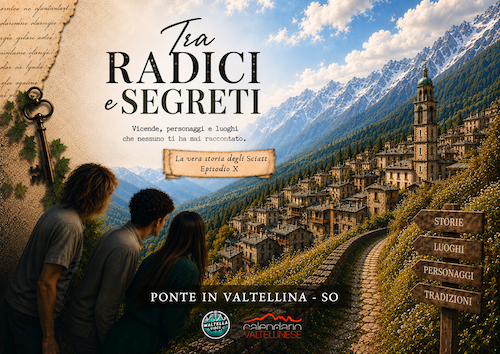
The real story of the sciatt is featured in the tenth episode of Tra Radici e Segreti, the video series that brings together Calendario Valtellinese and Waltella Vibes.
If you want to rewatch the reel, you’ll find it on our YouTube profile.