Villa of Tirano
A Roman bridge under which the River Adda no longer flows as of 1817, a 10,000-year-old bog above Aprica, and a festival held every October that fills the town with apples and grapes. This is Villa of Tirano, just a stone’s throw from Tirano.
Everyone knows Tirano for the Red Train, but before you get there, along State Road 38, there’s a town that many pass through without stopping—and that hurts, somehow.
Villa of Tirano is in mid Valtellina, immediately to the west of Tirano, on the Rhaetian side—the sunny one—where there are terraced vineyards and orchards.
It has about 3,000 residents, the villaschi, and a territory of 24.6 square kilometres that starts at the Swiss border, crosses the Adda valley floor and climbs up on the other side as far as Pian di Gembro, above Aprica. Besides the main town, it includes the hamlets of Stazzona and Motta.
A bit of history (short, I promise)
Until 1863, the village was simply called Villa. At the time of the Grisons, it was part of the Upper Quarter, the one that had Tirano as its administrative centre.
What to see
The Collegiate Church of San Lorenzo, rebuilt in the 17th century, is the heart of the town. San Lorenzo is also the patron saint, and he is celebrated on 10 August.
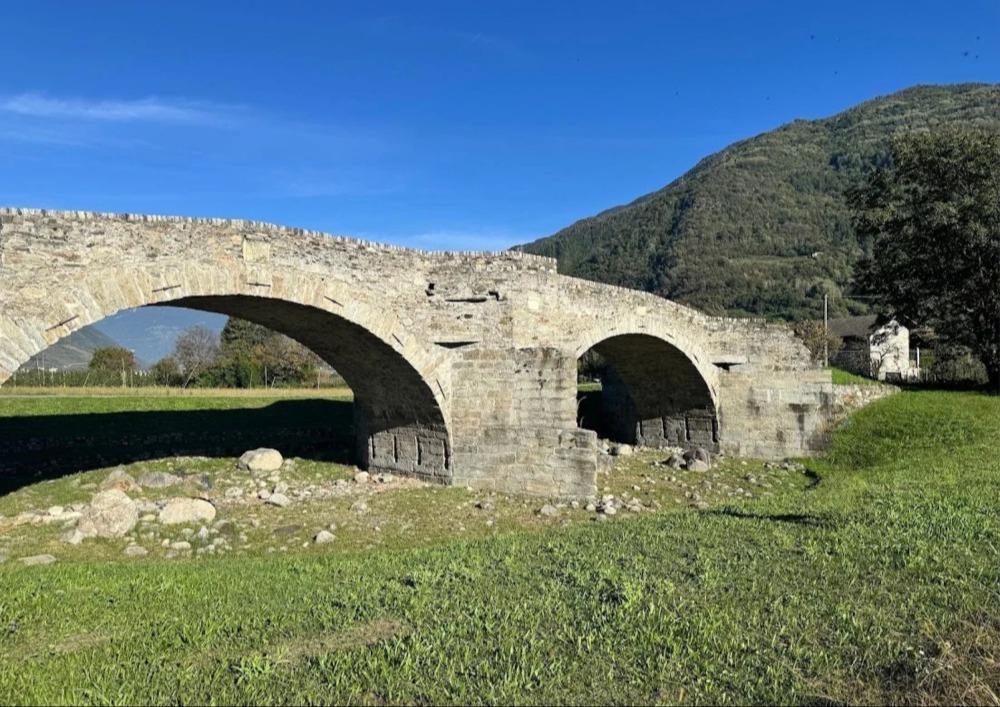
The Punt de Sass is a stone bridge with two arches, traditionally attributed to Roman times, with one special feature: nothing flows beneath it anymore. The Adda used to pass there until 1817; then a flood changed its course, and the bridge stayed put along State Road 38.
Palazzo Lambertenghi, on Strada della Motta, dates back to 1524 and is best admired from the outside.
Stazzona, on the other side of the Adda
Stazzona is the hamlet on the opposite bank of the Adda, on the Orobic side, facing Villa. Its heart is the Parish Church of Sant’Abbondio, rebuilt in the 17th century, and for centuries the Punt de Sass was what connected it to Villa.
Nature and walks
The Pian di Gembro Nature Reserve lies above Aprica, at around 1,350 metres, but it is part of Villa. It’s a bog formed about 10,000 years ago after a glacier retreated. There are 78 hectares protected within the European network Natura 2000, and it’s perfect to explore on foot along wooden walkways.
The Way of the Terraces—the 70-kilometre stretch between Morbegno and Tirano—passes through the vineyards of Maranta and della Campagna before the final descent towards Tirano. You can do it on foot or by bike, with the valley always right there in front of you.
What goes on in Villa
The Festival of Apples and Grapes takes place every year in October at the Polifunzionale and around the town’s streets, and it’s the weekend when Villa really fills up. It began in 1976 as a festival for local produce; in 1989 it became the Festival of Apples, and since 1997 it has also featured grapes, carrying forward the old name of Autumn Festival. You eat with the apple menu, buy local specialities, and set off on day trips organised by the Pro Loco.
Just before the festival comes the MelaVertical, a vertical kilometre with 1,000 metres of ascent in a little over 3 kilometres, on a historic mule track with gradients up to 51%.
In December, every year, the Christmas markets arrive, with the little wooden stalls in the square.
Once you’ve finished the loop, Tirano is only a few minutes away with the Sanctuary of the Madonna and the Red Train of Bernina—but now you know that Villa comes first, and that it deserves a proper visit.