What’s a bridge doing in the middle of a meadow in Villa di Tirano? The Ponte di Sasso crossed the Adda and linked Villa to Stazzona. On 27 August 1817, a flood submerged the valley floor and the river carved out a new channel, leaving the bridge high and dry. People also call it the Roman Bridge, but a Roman origin hasn’t been proved. The bridge is documented from the end of the fifteenth century, and nobody can say when it was built.
We went to Villa di Tirano, right by the bridge, to ask the question that anyone would ask when they see it there: what on earth is a bridge that big doing in the middle of a field? The answer is a story of the river. And it ends at the table.
Where is the Ponte di Sasso and what does it look like?
The Ponte di Sasso (in local dialect, Punt da Sass) is in the plain of Villa di Tirano, near the railway line and the SS38. It’s about 28 metres long, with two arches of roughly 12 metres each, and a central pier with supports that are almost triangular. Today’s river runs about 400 metres away.
The bridge didn’t spring up over a meadow. The landscape you see is different from the one it was built for. That’s why it’s listed as a geosite: it bears witness to changes along the valley floor.
Is the Ponte di Sasso really Roman?
They also call it the Ponte Romano. But the Roman origin hasn’t been proven, and the Comune and scholars say that historians have rejected that attribution.
What we can say is this: the first confirmation of the bridge dates to the end of the fifteenth century, and the 1495 records give the local authorities responsibility for works on the Adda, the bridge and the roads. Later it appears in documents from 1614 and 1659. When it was actually built is something nobody knows. (There’s also a mention of a bridge in Villa at the end of the thirteenth century, but it’s unclear whether it’s this one.)
Five stone tablets with dates from the seventeenth century and initials recall works carried out in 1683 and 1684. Two initials, VA and SA, are read as Villa and Stazzona. These are works, not the founding date. And today’s look includes restorations: the most recent conservation intervention was completed in 2000.
What does Stazzona have to do with the Romans?
The bridge connected Villa di Tirano to Stazzona, one of its hamlets on the other side of the valley. For the name Stazzona, the municipal document suggests it comes from Latin statio, meaning a stopping place, perhaps linked to ancient Roman routes. Treccani also lists “stazzone” as an old variant of “stazione”.
It’s a linguistic hypothesis, not proof. It doesn’t show that there was a coach station in Stazzona, and the Roman presence in the area doesn’t point to the bridge.
Where did the Adda end up? The 1817 flood
On 27 August 1817, during a flood, the Adda left its old course, flooded the valley floor and carved out a new channel away from the bridge. The bridge stayed dry. It wasn’t destroyed: it was the river that moved.
To reconnect the two banks, a new crossing was needed. According to the reconstruction in Paesi di Valtellina, which cites Garbellini, the project was by Luigi Lambertenghi in 1819, the construction site in 1822 with a contribution from Carlo Donegani, and the work was completed in 1824. The old bridge remained as a reminder of the river’s previous course.
The images with water under the arches, in our video, are an illustrative reconstruction created with AI.
What is the home restaurant Il Comò della Civetta?
After the bridge, we stopped in Stazzona at Silvia’s. The Comò della Civetta is a home restaurant: for Silvia, it’s her home and her kitchen, more than a restaurant in the way we usually think of one. You dine at her place, only by booking, with a fixed menu and a fixed price. She talks about “emotional tourism”, where people aren’t just customers, they’re guests.
In our article about the first night at the home restaurant, we explained how it works. Silvia walks us through the menu and asks in advance about allergies, preferences and intolerances. The shopping is done on the day itself, the food is prepared fresh, some of the vegetables come from her own garden, and the dishes aren’t pre-cooked. That evening, the menu included crostini, barley salad, curry chicken strips and apple fritters. For a guest who couldn’t tolerate lactose, Silvia prepared sweet sciatt.
When we arrived, she greeted us at the door and showed us the preparations. Near the kitchen there’s also another activity: the site offers tourist apartments and gift experiences.
How do Silvia’s cooking classes work?
The cooking classes are held at Silvia’s home: a traditional Valtellina cooking lesson, followed by dinner. According to the website, you learn to knead pizzoccheri dough and make sciatt and other traditional dishes. The course also covers cutting the cheese, the right cooking level for butter, quantities and some “little secrets” behind the recipes.
The recipes you can choose from include pizzoccheri, chisciöi, fresh pasta and ravioli. The chisciöi, in particular, is a typical dish from the Tirano area, made with a batter based on cheeses.
At the end of the course, as we said, you receive a certificate as a “pizzoccheratore”.
Where is Il Comò della Civetta?
📍 Via Piazza 7, Stazzona, Villa di Tirano (SO)
📞 +39 379 104 9040 (also WhatsApp)
✉️ info@ilcomodellacivetta.it
🌐 ilcomodellacivetta.it
Instagram: @ilcomodellacivetta
Facebook: Il Comò della Civetta
To book dinner or a course, you can use the “Contact us” form on the site, call, or write. The site says there are two cats at home, and that allergies and intolerances should be reported beforehand.
Frequently asked questions
Where is the Ponte di Sasso?
In the plain of Villa di Tirano, in Valtellina, near the railway line and the SS38.
Is the Ponte di Sasso a Roman bridge?
That’s what they call it, but the Roman origin hasn’t been proven. The bridge is documented from the end of the fifteenth century.
When was the Ponte di Sasso built?
Nobody knows. There isn’t a certain construction date: there are records, not a founding.
What’s a bridge doing in the middle of a meadow?
Once, the Adda ran here. After the flood on 27 August 1817, the river carved out a new channel and the bridge stayed dry.
What is an home restaurant?
A venue in a private home, where you eat as a guest. At Comò della Civetta, dinner is only by booking, with a fixed menu and set price.
Where can you take a cooking class near the Ponte di Sasso?
At Silvia’s, at the Comò della Civetta, in Stazzona. The course lasts 2 hours, plus dinner, and it’s for at least 2 people.
How much does a cooking class cost at Comò della Civetta?
According to the website, €55 per person, with dinner included.
We also tell the story in video
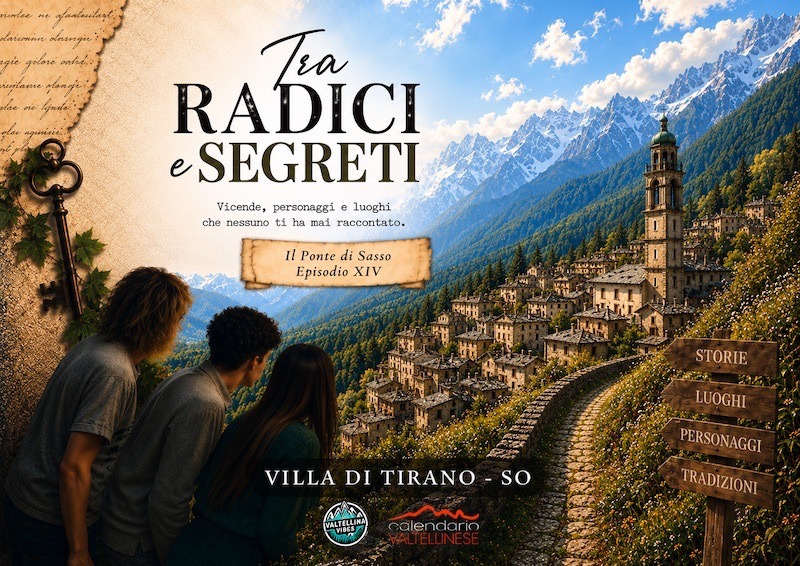
The Ponte di Sasso features in the 14th episode of Tra Radici e Segreti, the video series in which Calendario Valtellinese and Waltella Vibes collaborate.
Follow us on Facebook and on Instagram.