Why it was built right here
The sanctuary was founded during one of the most dramatic periods in the history of Valtellina.
Between 1620 and 1630, the valley was devastated by war, famine and epidemics. Until the terrible plague of 1630.
To ask for the protection of the Virgin Mary, the communities of Valtellina made a collective vow: to build a large Marian sanctuary. According to the historical reconstructions, the whole valley contributed to the cost.
Tresivio was chosen—back then it still held strong historical and religious prestige. On 30 November 1646, the first stone of the sanctuary was laid.
Before the Santa Casa, there was already a church
On the hill of Tronchedo, they did not build on “empty” land. Documents confirm that a church dedicated to Santa Maria already existed, documented at least from the 11th century.
- In 1016, it is mentioned in the sources.
- In 1094, it is described as a “basilica” (using the medieval sense of an important church).
- From 1106, it depended on the monastery of Sant’Abbondio in Como.
- Most likely, from the first half of the 12th century, a modest Benedictine community formed around the church.
So the 17th-century sanctuary was built in a place of worship that was already very ancient—devotion to Mary documented for more than six centuries before the construction of the Santa Casa.
The Santa Casa of Loreto in Valtellina
The sanctuary is dedicated to the Santa Casa of Loreto. Under the great dome, there is a replica of the Santa Casa of Loreto, built in the early 1700s: the first stone of this replica was blessed in 1701.
It is a small building set inside the main church, explicitly inspired by the famous Marian sanctuary in Le Marche. Inside, the Black Madonna is kept—a figure of particular devotion.
That very feature is what makes the sanctuary in Tresivio one of the most important “Lauretane Houses” in Northern Italy.
A construction that spanned several generations
Construction began in 1646, but it carried on for many decades, through the 17th and 18th centuries, until 1790.
Key milestones include:
- 1646: the laying of the first stone;
- 1701: creation of the internal Santa Casa;
- 1780–1790: completion of numerous altars and the end of the main phase of the works.
During the 18th and 19th centuries, the bell tower was also built. Even during the 1833 pastoral visit, Bishop Carlo Romanò pointed out numerous cracks in the building, to the extent that he feared it might have to be shut. Only with major restorations carried out in the 20th century and in the first years of the 2000s did the sanctuary regain full stability.
Interiors that look like stone (but are actually wood)
There’s a detail that many visitors don’t notice straight away.
The interiors of the Santa Casa appear to be clad in stone and marble. Columns, cornices, decorations: everything gives the impression of a noble, heavy, “proper big sanctuary” material.
In reality, much of what you see is wood.
The choice wasn’t random. The community of Tresivio and the families in the valley had to build the sanctuary “on a budget”, with limited resources and a building site that had been going on for decades. Wood made it possible to achieve effects similar to stone, with far lower costs and weight.
The result is a play of materials and finishes that plays tricks on the eye: it looks like marble, but it’s finely worked wood.
The sanctuary as a religious symbol of Valtellina
The sanctuary is considered one of the most important religious symbols in the valley, not only because of its size (it is regarded as the largest church in Valtellina), but also for its historical and spiritual meaning.
Some key elements:
- it is an ex voto from all of Valtellina after the wars and the plague of 1630;
- it stands in a dominant position among the vineyards on the hill of Tronchedo, and can be seen from much of the valley;
- it is dedicated to the Nativity of the Virgin, celebrated on the 8 September, and is a destination for devotion and pilgrimages.
What should be said clearly
Not all the stories circulating about the Santa Casa are documented.
Some are popular traditions, like the legend of the stone that fell from the Santa Casa during the “flight” from Nazareth to Loreto. According to the tale, a stone would have fallen right on the hill of Tresivio, and from there local devotion would have begun.
Fascinating—but with no historical proof.
Opening times for the Sanctuary
The Sanctuary is open to visitors every Sunday from 15:00 to 18:00.
For groups of at least 5 people, it’s possible to arrange guided tours with volunteers who tell the historical story of the Santa Casa. Tel. Don Augusto 339 3089540
We also tell the story in video
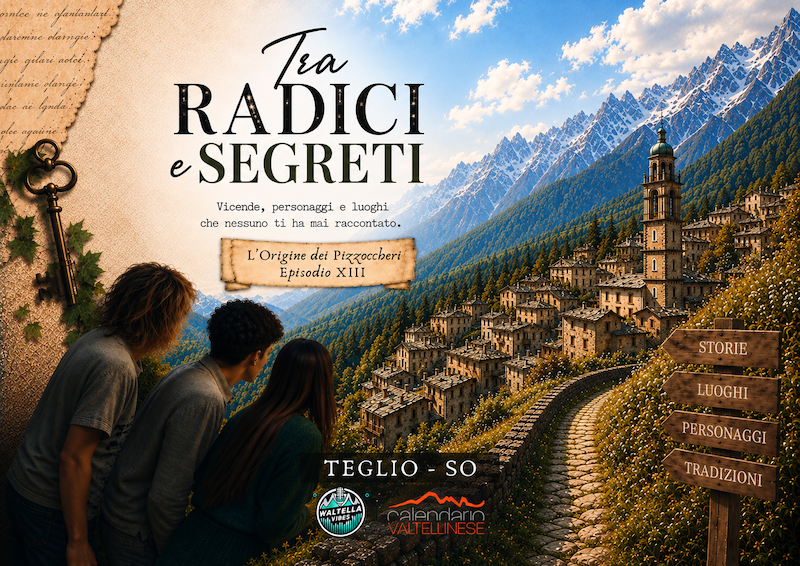
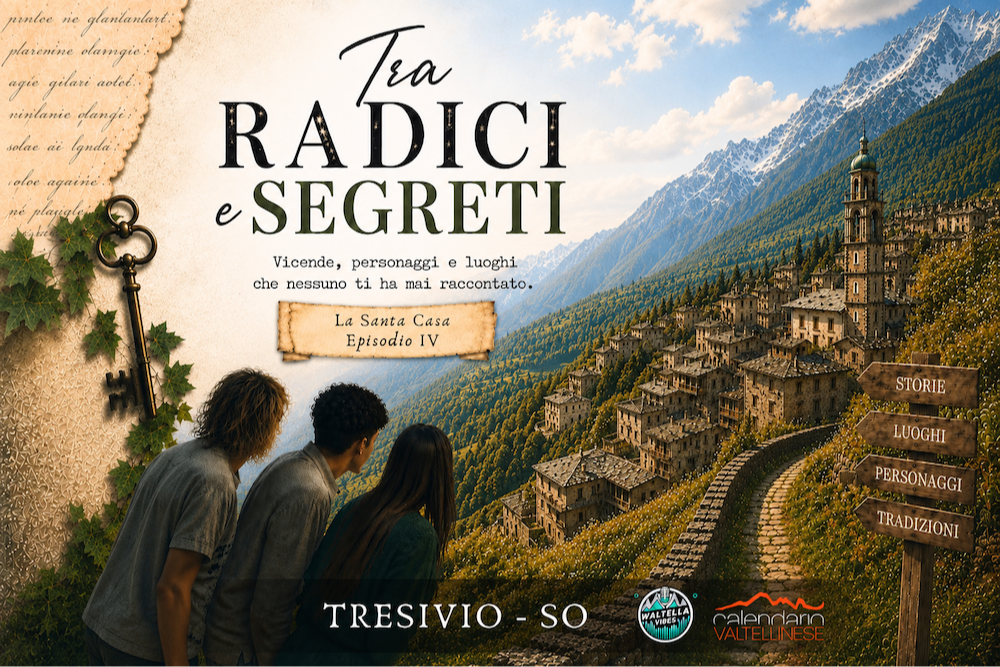
The story of the Santa Casa of Tresivio is the focus of the fourth episode of Tra Radici e Segreti, the video series in which Calendario Valtellinese and Waltella Vibes team up.
If you want to watch the reel again, you’ll find it on our YouTube profile