Sources
Luigi De Bernardi, Evalchia Vennasco, Valtellina almanac
Eugenia Tognotti, 1918-1919 “Spanish flu” in Italy, VaccinarSì
University of Milan, La gran morìa: the “Spanish flu” epidemic in Milan in the winter of 1918
Novecento.org, The great pandemic of the twentieth century
Toscana Novecento, The “cruel malady” of the autumn of 1918
October 1918: the Spanish flu arrives
Fri, 23/10/2026 - blog
Fri, 23/10/2026 - blog
October 1918: the Spanish flu arrives
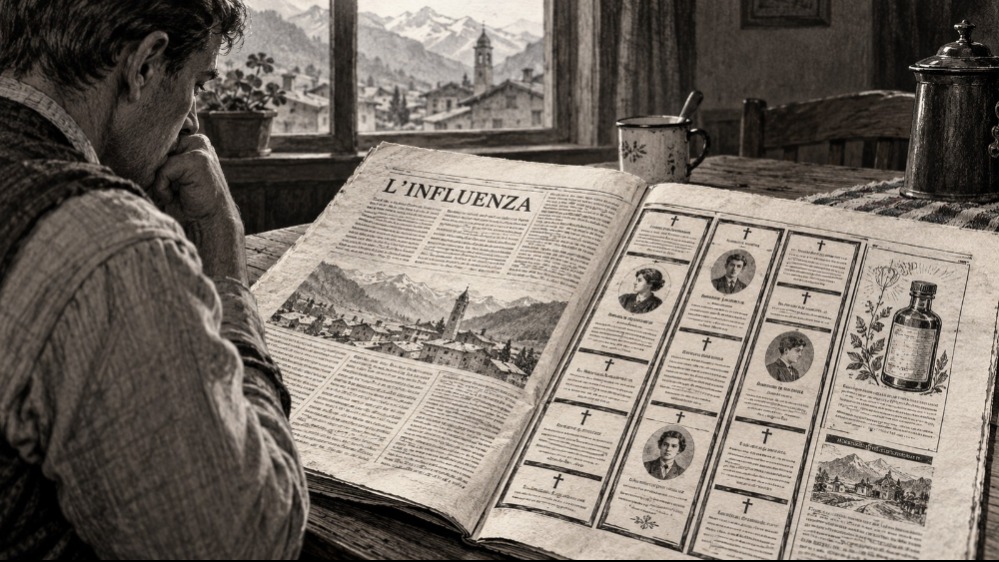
On 23 October 1918, the newspaper “La Valtellina” published an article entitled “The influenza”. It talks about the Spanish flu, and the tone is reassuring: “in general, if the illness is dealt with properly and in time, it runs a short and favourable course and should not lead to excessive worry.” Luigi De Bernardi, who records the news in his almanac, ends with a blunt line: the facts will spectacularly disprove those predictions.
“La Valtellina” wasn’t alone. Flicking through the newspapers of that autumn, you come across long columns of obituaries, often of young people, alongside articles that downplayed the health crisis and ads for products said to ward off influenza. Grief underneath, reassurance above (and the advert alongside).
Even the name was wrong. It’s called “Spanish” because the first warning about the illness came from Spain, a country that wasn’t at war and therefore had no censorship. Newspapers from countries at war were all buttoned up; the Spanish ones wrote openly, and so the influenza took a passport that wasn’t its own.
In Italy it arrives in waves: the first in spring 1918, the second in autumn, and the third between the winter and the early months of 1919. That autumn one is the worst: in the autumn of 1918, over the space of just a few weeks, Spanish flu causes around 400,000 deaths across the Peninsula. When that article is published, we’re right inside those weeks.
Just look at Milan, a couple of hours from here. In Milan, in September alone, more than 850 people already die from influenza or its lung complications, nearly 3,000 in just the month of October, almost 800 in November and more than 900 in December.
And that “dealt with properly and in time” was quite a plan, on paper. Much of the medical staff, nurses and pharmacists were at the front; medicines were in short supply, and even basic necessities for the sick and convalescents. No vaccines—authorities advised avoiding infection and taking great care with cleanliness of hands, nose and mouth. Soap, in practice, and a lot of hope.
Then the rules arrive, which, if you read them today, have quite an effect (anyone who lived through 2020 will recognise them one by one). Between late September and early October, mayors and health officials, following the circulars from the Ministry of the Interior, order the isolation of patients, the closure of schools, and the bare minimum of gatherings in theatres and cinemas. And still, it’s forbidden to go and visit the sick, go to church, offer condolences to the families of the deceased—a very deeply rooted custom—and to attend funerals.
It hit people who least expected it, especially young adults, who until the day before had been fine. Italy was the worst-hit country in Europe alongside Portugal, with 600,000 victims, almost as many as Italian soldiers who died in the Great War.
The day after that issue comes out, on 24 October 1918, the Battle of Vittorio Veneto begins. On 4 November the armistice is signed and the war ends; the Spanish flu, with its short and favourable course, will keep going from house to house all winter.
blog